Enact Statistic Definitions & Formulas
Enact derives the Capability Ratio rollups across multiple Part-Process-Feature (PPF) streams from the weighted proportional fallout of each stream residing in a given rollup row. Because of this, different specification limits among the PPF streams do not cause an issue. When determining the capability ratio, Enact does not include PPF streams without specification limits in the fallout intermediate calculation, since Enact can't calculate the fallout for that PPF. For unilateral specification limits, Enact will only consider the fallouts for the side where specification limits exist.
-
Avg Deviation. Average data point deviation from their mean, which is a more robust estimate of the variability than the variance or standard deviation.
 Formula
 -
Chi-Squared. General statistic that compares observed values to expected values. The Goodness of Fit test uses the Chi-Squared statistic to assess if the observed values in the data set exhibit the distributional characteristics of a normal distribution. More specifically, the test compares the observed values in a given histogram bin to the expected values that should be in that bin if the distribution was indeed normal.
Formula -
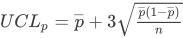
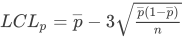
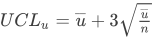
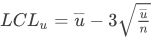
Control Limits. Statistic that is calculated from collected data, showing how the process is performing.
-
CoVar. Ratio of the long term standard deviation (SD) to the mean, expressed as a percent. Also known as coefficient of variation.
Formula -
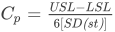
Cp. Capability ratio using short-term standard deviation, comparing the specification limit spread to the spread of the variation of the data stream.
Formula -
Cpk. Capability ratio that is adjusted for non-centered processes, using short-term standard deviation, comparing the specification limit spread to the spread of the variation of the data stream. Cpk is equal to the smaller of Cpu or Cpl.
Formula -
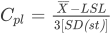
Cpk Lower. Difference between the process mean and the lower specification limit, divided by three standard deviations. The standard deviation is estimated using the short-term Rbar method.
Formula -
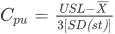
Cpk Upper. Difference between the upper specification limit and the process mean, divided by three standard deviations. The standard deviation is estimated using the short-term Rbar method.
Formula -
Cpm. Variation between the process average and target value as well as the process standard deviation, where T is the target value. The standard deviation is estimated using the short-term Rbar method.
Formula -
Cr (1/Cp). Inverse of the Cp.
Formula -
F-Ratio. Mean Square Between divided by Mean Square Within.
Formula -
Kurtosis. Degree of peakedness or flatness of the distribution relative to a normal distribution (Positive Value The distribution is more pointed; Negative Value The distribution is more rounded; 0 (zero) The distribution is normal).
Formula -
LSL(Z) Long-Term. Lower specification limit expressed in units of long-term standard deviations from the distribution mean. Also known as Z score or Z value. If the lower specification limit is larger than the mean, the LSL(Z) will be a negative number.
Formula -
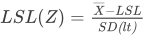
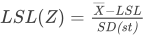
LSL(Z) Short-Term. Lower specification limit expressed in units of short-term standard deviations from the distribution mean. Also known as Z score or Z value. If the lower specification limit is larger than the mean, the LSL(Z) will be a negative number.
Formula -
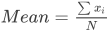
Mean. Arithmetic average of a given data set, where N represents the number of values in the data set.
Formula -
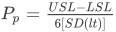
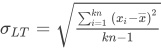
Pp. Ratio of the process variability (six sigma) with the width of the specification limits (total tolerance). The standard deviation (sigma) is calculated using the root mean square method (RMS).
Formula -
Ppk. Capability ratio that is adjusted for non-centered processes, using long-term standard deviation, comparing the specification limit spread to the spread of the variation of the data stream. Ppk is equal to the smaller of Ppu or Ppl.
Formula -
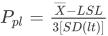
Ppl. Difference between the lower specification limit and the process mean, divided by three standard deviations. The standard deviation (sigma) is calculated using the root mean square (RMS) method.
Formula -
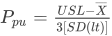
Ppu. Difference between the upper specification limit and the process mean, divided by three standard deviations. The standard deviation (sigma) is calculated using the root mean square method (RMS).
Formula -
Ppm. Variation between the process average and target value as well as the process standard deviation, where T is the target value. The standard deviation is calculated using the root mean square (RMS) method.
Formula -
Pr (1/Pp). Inverse of the Pp.
Formula -
Robustness. Ratio of short term to long term standard deviation, expressed as a percent. The closer this percent is to 100, the more stable the process is over time.
Formula -
Standard Deviation. Variation representing the average deviation of values from their mean, often called sigma because the Greek letter sigma is used as a symbol for standard deviation.
Formula -
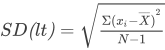
SD (lt). Variation representing the average deviation of values from their mean, often called the RMS (root mean square) method of calculating sigma.
Formula -
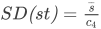
SD (st). Short-term process variation estimated from either the within-subgroup standard deviation (for n > 1) or moving standard deviation (for n = 1) of the subgroups.
Formula -
SIGL (lt). Sigma level based on the long-term sigma.
Formula -
SIGL (st). Sigma level based on the short-term sigma.
Formula -
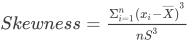
Skewness. Degree of asymmetry of the distribution of test values about the mean value, which characterizes the shape of the distribution (Positive Value Skewness tail extends out to a more positive value; Negative Value Skewness tail extends out to a more negative value).
Formula -
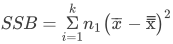
SS Between. Sum of Squares Between. Variation between the subgroup means. The Degrees of Freedom used to evaluate the F-Ratio (d.f.=k-1).
Formula -
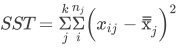
SS Total. Sum of Squares Total. Sum of the Sum of Squares Between and the Sum of Squares Within.
Formula -
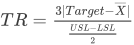
Target Ratio. Measurement that determines if the process is centered on the target value (0 Process mean is equal to target value and process is centered; 1 Process is off-center from target ratio; >0 and <1 Include Cp with Target Ratio to determine if process is centered, as recommended by Phillips).
Formula -
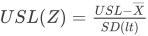
USL(Z) Long-Term. Upper specification limit expressed in units of long-term standard deviations from the distribution mean. Also known as Z score or Z value. If the upper specification limit is smaller than the mean, the USL(Z) will be a negative number.
Formula -
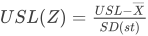
USL(Z) Short-Term. Upper specification limit expressed in units of short-term standard deviations from the distribution mean. Also known as Z score or Z value. If the upper specification limit is smaller than the mean, the USL(Z) will be a negative number.
Formula -
Variance. Spread of data about the mean.
Formula -
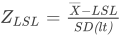
Z LSL. Lower specification limit expressed in units of standard deviations from the distribution mean. Also known as Z score or Z value. If the lower specification limit is larger than the mean, the Z LSL will be a negative number.
Formula -
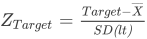
Z Target. Target expressed in units of standard deviations from the distribution mean (Negative Value Target is smaller than the mean; Positive Value Target is greater than the mean; 0 (zero) Target and mean are equal).
Formula -
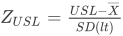
Z USL. Upper specification limit expressed in units of standard deviations from the distribution mean. Also known as Z score or Z value. If the upper specification limit is smaller than the mean, the Z USL will be a negative number.
Formula